A Brief Time Travel Into the Age of AI
In 1972, a German TV documentary imagined TV shopping. The idea was right, the path completely different. What can we learn from that for the AI future?
There's an old German TV documentary from 1972 that I keep stumbling across: "Richtung 2000 — Preview of Tomorrow's World" by Arno Schmuckler and Peter Kerstan. The film tries to show what life in the year 2000 might look like. I've never watched it in full — more like catching random clips on YouTube over the years, a few minutes at a time.
And every time, it feels both progressive and completely alien at the same time. Progressive because you see video telephony, automated households, digital information systems, and electronic communication — things that actually became reality. Alien because the technical means seem almost quaint by today's standards.
My favourite example: "TV Shopping". In the documentary, the viewer sits at home in front of the television. A camera crew walks through a supermarket filming the shelves. When the viewer wants to buy a product, they press a button — and the product lands in their shopping cart.
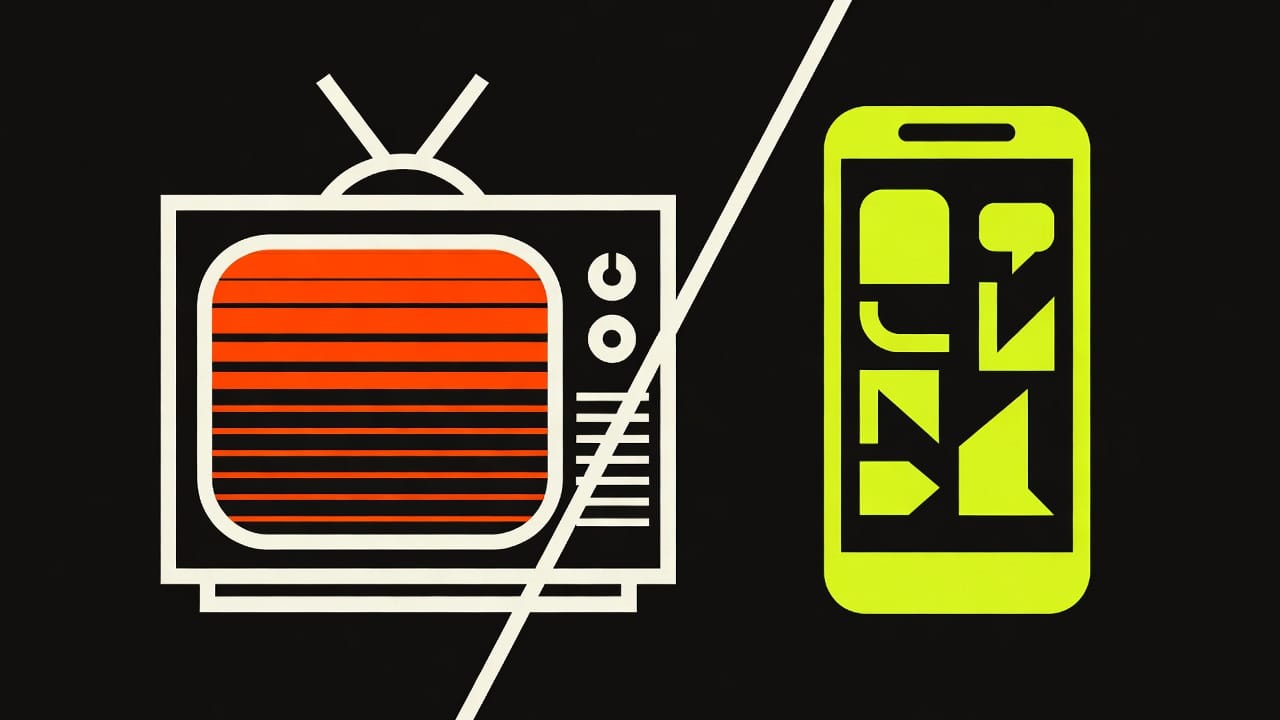
From today's perspective, it's almost comical. Because we know how this problem was actually solved: not through television — but through the internet, smartphones, and online shops. The idea was right. The path was completely different.
Why I bring this up
What fascinates me about this documentary isn't just the content — it's the tone. There's a genuine sense of pioneering spirit, a real curiosity about what's to come. The makers did warn about risks — about loneliness in automated homes, about the loss of human connection. But the underlying tone wasn't fear. It was an attempt at a sober, curious look forward. Technology as something you can shape — not something you're subjected to.
Today, over fifty years later, I notice how differently the current debate is often conducted. Either total euphoria or dystopian anxiety. I sometimes miss that sober, curious gaze from the documentary.
The makers imagined the future as an extension of what they already knew: TV becomes interactive, computers remain large machines, communication runs through video phones. What they couldn't foresee: the internet, mobile computers, platform economics, artificial intelligence. The future rarely emerges from linear progression. It emerges from combinations of technologies that nobody had previously connected.
And that's exactly why we should be cautious today with overly confident predictions — but equally with overly confident fears. What follows isn't an attempt at prediction. It's a thought experiment in the spirit of that documentary: curious, sober, open. A plausible trajectory. Many details will probably be wrong. But perhaps the direction will turn out to be surprisingly accurate.
The fear isn't new
Before I look ahead, it's worth a brief glance backwards. Because the fear of technological change is as old as the change itself.
In the early 19th century, English weavers — the so-called Luddites — destroyed mechanical looms because they feared for their livelihoods. The fear was real and understandable. In the short term, many hand weavers did lose their work. But in the medium term, the textile industry made clothing so affordable that it became accessible to broad populations — and in the process created significantly more jobs than it had destroyed.
When Henry Ford introduced the assembly line in 1913, similar fears arose. The assembly line did radically change work. But it also lowered production costs so dramatically that ordinary workers could suddenly afford a car. An entire middle class emerged.
In the 1970s, many predicted that ATMs would mean the end of bank tellers. The opposite happened: because branches became cheaper to operate, banks opened more of them — and hired more people.
The pattern repeats: short-term disruption and legitimate concerns. But in the medium and long term, every major wave of automation has increased prosperity, created new professions, and made affordable what was previously a luxury. The world has never become permanently worse because of these advances.
I'm not saying this to dismiss legitimate concerns. The transition phases are real and hard for those affected. But history also shows: if you only see the losses, you miss the opportunities emerging at the same time.
2026 — AI becomes an everyday tool, agents gain visibility
We're writing the year 2026, and AI has already become a tool in many fields. People use it for writing, research, programming, design, analysis, and planning. In some knowledge work, AI tools enable time savings of 20–30 percent.
What's particularly notable this year: AI agents are gaining broader attention for the first time. Not just in tech circles, but in general awareness. Autonomous systems that don't just respond but independently work through tasks — for most people, this was science fiction two years ago. Now the first companies are seriously experimenting with them.
I use agents daily in my work now. Many tasks I still did manually in 2024, I delegate today. This initially changes the structure of jobs more than their existence. A developer writes less code themselves. An analyst spends less time preparing data. A designer tests more variants. Work doesn't disappear — it shifts.
2028 — Software gets commissioned, not operated
The next step is already emerging: agents become the standard interface. Instead of solving a problem yourself, you describe the goal. "Plan a three-day trip to Barcelona under 800 euros" — and an agent compares flights, checks hotels, analyses reviews, and creates a travel itinerary.
Similar systems are emerging for software development, data analysis, marketing, and IT administration. Companies begin treating digital agents not as experiments but as permanent team members.
2030 — Knowledge work changes noticeably
Analyses like those from the McKinsey Global Institute estimate that by 2030, around 30 percent of today's working hours could be automated. Importantly: this doesn't mean 30 percent of jobs disappear. It means many activities become partially automated.
A consultant spends less time on research and data preparation, more on interpretation, strategy, and client conversations. Many jobs shift from production to decision-making and evaluation. Just as the Luddites couldn't foresee that the textile industry would eventually employ more people, we probably can't yet see which new fields of work are emerging right now.
2035 — The robotics wave begins
While AI initially transforms the digital world, the physical world starts catching up in the second half of the 2030s. Robots become cheaper and more capable. Modern logistics centres already operate with tens of thousands of autonomous systems for transport and sorting.
In the coming decades, robots could increasingly appear in construction, agriculture, care assistance, and hospitality. Automation of the physical world moves slower than the digital — but it's progressing.
2040 — Productivity reshapes the economy
When machines take on more work, productivity rises. And here the historical pattern repeats: industrialisation lowered production costs and made goods more affordable. The assembly line democratised the car. The computer made knowledge accessible.
AI could have a similar effect. Software, knowledge, and digital services could become drastically cheaper. Entire industries that are currently affordable only for large companies — individualised consulting, tailored education, specialised analysis — could suddenly become accessible to everyone. This gradually changes the structure of companies too: smaller teams, but significantly greater impact.
2045 — Collaboration, not replacement
In my view, many professions will continue to exist — but in altered form. A doctor works with AI diagnostic systems. An engineer tests designs first in simulations. A teacher uses personalised learning platforms. The human role shifts increasingly toward evaluation, contextual understanding, responsibility, and creative problem-solving.
2050 — A different working reality
If automation continues to increase, the relationship between work and leisure could also shift. In the 19th century, many people worked over 60 hours per week. Today, average working hours in many industrialised countries sit at 35–40 hours. Technological productivity was a central driver of this development. The AI revolution could continue this trend — not because work disappears, but because less of it is needed to maintain the same or a higher standard of living.
What we can learn from this
When I look back at the 1972 documentary, I see something interesting. Many specific ideas were wrong. But the fundamental intuition was right: the world would become more digital, more connected, and more automated.
Something else stands out too: the documentary's underlying tone was optimistic. The makers saw technology as an opportunity, not a threat. Perhaps we can take a page from that book. Not naively — the transition phases are real and deserve attention. But history also shows that every major wave of automation ultimately created more than it destroyed. More prosperity, more possibilities, more time for the things that truly matter.
Perhaps in a few decades, people will look back at our current visions of the future and say: the details were off. But the direction was surprisingly clear.
The future isn't pre-programmed. But it has a direction. And if history is any indicator, there's good reason to face that direction with confidence.